

512×512 training and 1024×1024 evaluation across eight metrics, using DrawBench and the official GenEval2 setting.
Anysampling stepsnative MeanFlow inference
6 / 8best image metricsamong few-step RL-tuned generators
+1.76VBench totalvs. LongCat Video RL · 50 steps
10×fewer evaluationsvs. 40-step DiffusionNFT
TL;DR
- First forward-process RL for MeanFlow. A DiffusionNFT-style objective on an induced instantaneous-velocity predictor keeps training likelihood-free and leaves the few-step sampler unchanged.
- Provable improvement. In an idealized setting the induced optimum matches DiffusionNFT's improved policy, and the gain provably carries over to the deployed average-velocity generator.
- State-of-the-art few-step generation. Consistent gains on image (SD3.5-M) and video (Wan2.1 1.3B); with only 4 steps it surpasses multi-step RL and scales gracefully at test time.
Method
Optimize reward in instantaneous-velocity space, while preserving MeanFlow's native average-velocity parameterization and efficient few-step sampler.
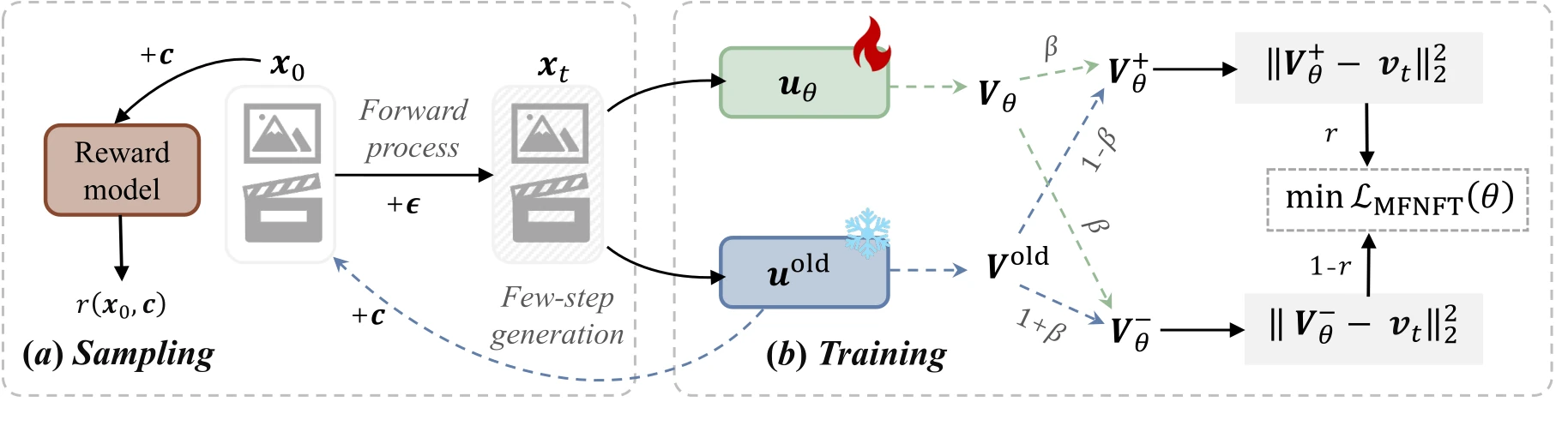
Algorithm 1MeanFlowNFT (one update step)
Require: pretrained MeanFlow uθ, frozen reference uold (EMA of uθ), reward r, guidance β
// Sampling
- Sample prompt c; roll out x0 with uold; evaluate r(x0,c) ∈ [0,1].
- Sample an interval s ≤ t, and ε ∼ N(0,I).
- xt ← αt x0 + σt ε; vt ← α̇t x0 + σ̇t ε.
// Training
- x(t±Δt) ← xt ± Δt vt
- d ← [uold(x(t+Δt),s,t+Δt) − uold(x(t−Δt),s,t−Δt)]/(2Δt)
- Vθ ← uθ(xt,s,t) + (t−s)d
- Vold ← uold(xt,s,t) + (t−s)d
- Vθ+ ← (1−β)Vold + βVθVθ− ← (1+β)Vold − βVθ
- LMFNFT ← r‖Vθ+−vt‖² + (1−r)‖Vθ−−vt‖²
- Update θ by ∇θ LMFNFT.
Quantitative Results
Among few-step models, bold = best and underline = second-best. Our method is highlighted in green.
480p, 81-frame generation; VBench and four reward metrics are measured on 256 held-out prompts.
LoRA rank 32 with AdamW at 3×10⁻⁶; native MeanFlow sampling is retained at inference.
Table 1. Image generation on SD3.5-M at 1024×1024.
| Method | ImageReward↑ | CLIPScore↑ | Aesthetic↑ | PickScore↑ | HPSv2↑ | HPSv3↑ | GenEval2↑ | OCR↑ |
|---|---|---|---|---|---|---|---|---|
| Multi-step models (40 steps) | ||||||||
| SD3.5-M (w/o CFG) | -0.4770 | 0.2391 | 5.1514 | 20.6587 | 0.2109 | 3.4601 | 0.1171 | 0.1439 |
| + DiffusionNFT | 1.4066 | 0.2889 | 5.9647 | 23.6440 | 0.3236 | 13.5959 | 0.2613 | 0.9098 |
| SD3.5-M (w/ CFG) | 0.9253 | 0.2880 | 5.3811 | 22.4638 | 0.2822 | 11.2489 | 0.2038 | 0.5449 |
| + Flow-GRPO | 1.0193 | 0.2912 | 5.2843 | 22.4783 | 0.2657 | 9.8059 | 0.2638 | 0.6282 |
| Few-step models (4 steps) | ||||||||
| DMD | 0.9241 | 0.2841 | 5.5055 | 22.2807 | 0.2874 | 11.7156 | 0.2042 | 0.3996 |
| CDM | 1.0307 | 0.2819 | 5.5721 | 22.4160 | 0.2976 | 12.5190 | 0.2020 | 0.3225 |
| AnyFlow | 1.1125 | 0.2886 | 5.4203 | 22.4789 | 0.2969 | 12.0691 | 0.1896 | 0.4520 |
| RTDMD | 1.2315 | 0.2775 | 6.1290 | 23.2825 | 0.3265 | 13.9253 | 0.2042 | 0.2965 |
| Rdm | 0.7236 | 0.2720 | 5.7537 | 22.0748 | 0.2759 | 11.2115 | 0.1619 | 0.3759 |
| DMD + DiffusionNFT | 0.7158 | 0.2843 | 5.3784 | 21.9571 | 0.2708 | 9.6985 | 0.2249 | 0.4865 |
| CDM + DiffusionNFT | 0.1455 | 0.2745 | 4.8335 | 21.3849 | 0.2143 | -3.2834 | 0.2103 | 0.3303 |
| AnyFlow + DiffusionNFT | 1.2394 | 0.2915 | 5.9489 | 23.0876 | 0.2919 | 12.1378 | 0.2335 | 0.5948 |
| MeanFlowNFT (Ours) | 1.4504 | 0.2967 | 5.9275 | 23.5019 | 0.3269 | 13.8826 | 0.2375 | 0.6534 |
With only 4 steps, MeanFlowNFT matches or exceeds the 40-step forward-process RL method DiffusionNFT on several reward metrics at ~10× fewer function evaluations.
Table 2. Video generation on Wan2.1 1.3B. VBench scores and four metrics on 256 held-out prompts (HPSv3-G/-P: HPSv3 general/percentile; MQ/TA: VideoAlign motion-quality/text-alignment).
| Method | VBench Total↑ | Quality↑ | Semantic↑ | HPSv3-G↑ | HPSv3-P↑ | MQ↑ | TA↑ |
|---|---|---|---|---|---|---|---|
| Multi-step models (50 steps) | |||||||
| Wan2.1 1.3B (w/ CFG) | 82.94 | 84.69 | 75.97 | 3.9099 | 8.2868 | 0.8684 | 1.2255 |
| + LongCat-Video RL | 82.57 | 84.44 | 75.10 | 4.7099 | 9.2730 | 0.5493 | 1.6321 |
| Few-step models (4 steps) | |||||||
| rCM | 82.43 | 84.58 | 73.82 | 3.9660 | 8.7198 | 0.2740 | 1.6290 |
| DMD | 82.64 | 84.65 | 74.57 | 3.8598 | 8.7955 | 0.1810 | 1.6845 |
| SC-DMD | 83.36 | 84.76 | 77.77 | – | – | – | – |
| AnyFlow | 83.71 | 85.36 | 77.11 | 6.0536 | 10.450 | 0.7504 | 1.7356 |
| MeanFlowNFT (Ours) | 84.33 | 85.99 | 77.68 | 6.5959 | 10.793 | 0.9535 | 1.7235 |
Test-time scaling
Because uθ approximates the average velocity over any interval, MeanFlowNFT supports any-step inference (N ∈ {2,4,8,16,32}). Most metrics improve with more steps, and MeanFlowNFT is markedly more step-consistent than AnyFlow.



Training stability

Qualitative Comparison
Interactive side-by-side gallery. Text-to-Image uses SD3.5-M (1024×1024); Text-to-Video uses Wan2.1 1.3B (832×480, 81 frames). Browse each track with the ‹ › buttons, by swiping, or with the ←/→ keys; click any sample to enlarge.
BibTeX
@misc{huang2026meanflownftbringingforwardprocessrl,
  title   = {MeanFlowNFT: Bringing Forward-Process RL to Average-Velocity Generators},
  author  = {Huang, Yushi and Zhou, Xiangxin and Zhang, Jun and Bo, Liefeng and Pang, Tianyu},
  year    = {2026},
  eprint={2607.15273},
  archivePrefix={arXiv},
  primaryClass={cs.CV},
  url={https://arxiv.org/abs/2607.15273},
}